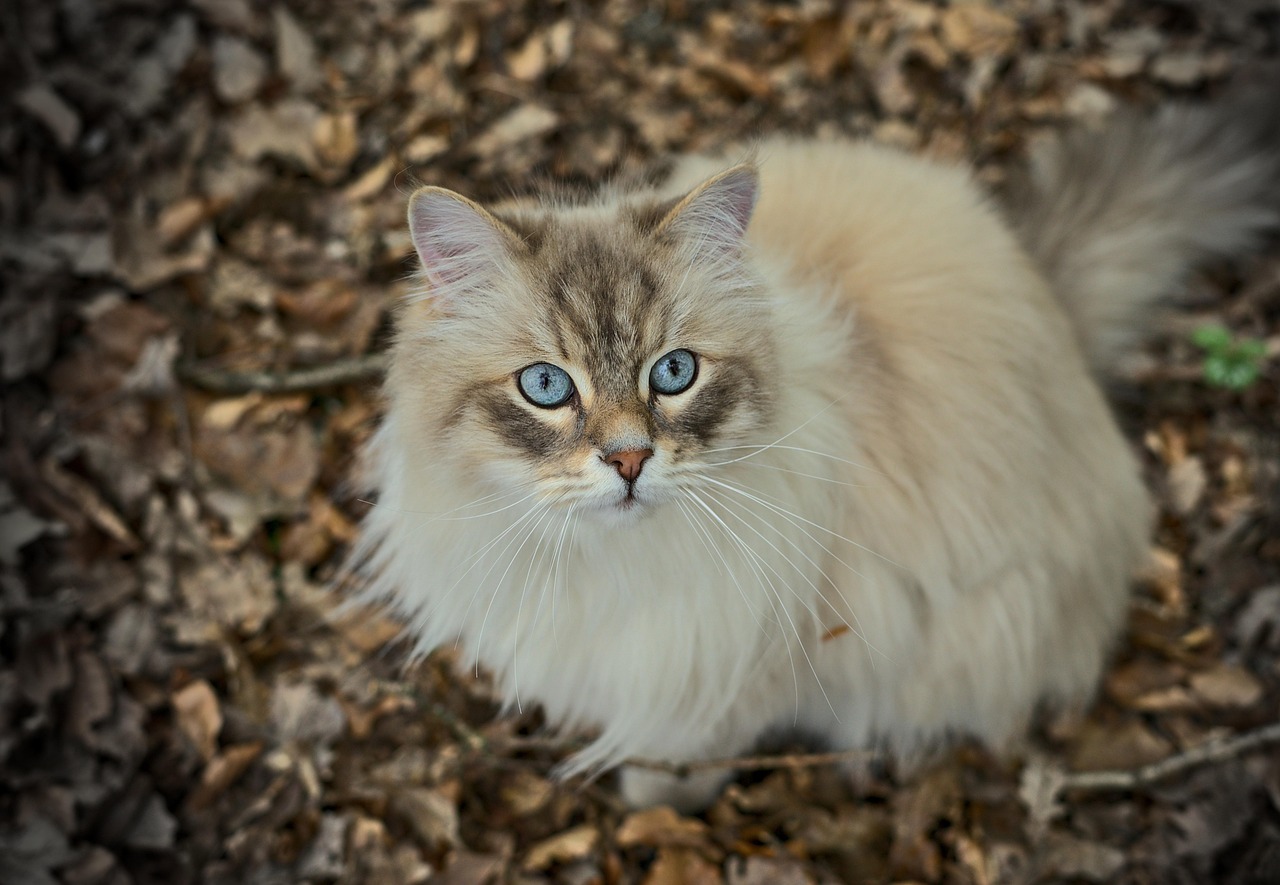
A Neva Masquerade cat is the colourpoint variety of the Siberian cat. Same breed, same heavy triple coat, same sociable temperament — the difference is purely in the pattern: a pale body with darker pigment restricted to the face mask, ears, legs and tail, and almost always blue eyes. If you’re picturing a large, semi-longhaired cat with a dark mask over a cream body, that’s a Neva Masquerade.
The name itself is worth unpacking, because it tells you something about how this variety is regarded. “Neva” comes from the Neva River in St Petersburg. “Masquerade” refers to the mask. It’s a Russian breed name for a Russian cat, and it has stuck even in registries that treat the Neva Masquerade as simply a colour division of the Siberian rather than a separate breed.
Is a Neva Masquerade cat a different breed from a Siberian?
No. In most registries the Neva Masquerade is a Siberian cat with colourpoint markings, not a separate breed. The two are interbred freely, share the same standard for body, coat and temperament, and can appear in the same litter.
This is the single most confusing thing about the name, so it’s worth being clear. Some registries have at points recognised the Neva Masquerade as its own breed; others classify it as a colour variant within the Siberian. Either way, the cat in front of you is a Siberian: large, slow-maturing, triple-coated, and colourpoint.
Practically, this matters for two reasons. First, if you’re looking for a Siberian and you see “Neva Masquerade” advertised, you’re looking at the same animal with a different coat pattern — not a distinct breed with distinct needs. Second, if you’re specifically after the colourpoint look, you’ll want to ask the breeder directly, because colourpoint kittens are only produced when both parents carry the relevant gene.
What does “colourpoint” actually mean?
Colourpoint is a temperature-sensitive pigment pattern. The pigment-producing cells only activate in the cooler parts of the body — the extremities — which is why the mask, ears, legs and tail are dark while the torso stays pale. Kittens are born almost entirely white and develop their points over the first weeks and months.
The classic colourpoint palette in the Neva Masquerade includes seal, blue, tabby-point, tortie-point and red-point variations. The eyes are typically blue, ranging from pale ice to a deeper blue, and the contrast between eye colour and mask is part of the appeal.
One practical quirk: because the pattern is temperature-dependent, a colourpoint cat kept in a cooler environment may develop slightly darker points over time. It’s subtle, and it isn’t something you need to manage — but it explains why a Neva Masquerade’s mask can deepen as the cat ages.
What does a Neva Masquerade cat look like?
A Neva Masquerade is a large, semi-longhaired cat with a dense triple coat, a rounded muzzle, substantial bone, and a colourpoint mask with blue eyes. Males typically reach 5–9 kg, and the breed can take three to five years to reach full size.
The coat is the headline feature, and it’s the same coat as any other Siberian: three layers — guard hairs, awn hairs and a thick undercoat. That undercoat is what makes the breed so well suited to cold climates and so demanding to groom. The Neva Masquerade’s paler body means the texture and density of that coat are very visible; there’s nowhere for a grooming lapse to hide.
| Feature | Typical Neva Masquerade |
|---|
—|
| Coat | Semi-longhaired, dense triple coat |
|---|
Colourpoint — dark mask, ears, legs, tail; pale body |
| Eye colour | Blue (range of shades) |
|---|
Large; males often 5–9 kg |
| Maturity | Slow — full size around 3–5 years |
|---|
Heavy seasonal shed, especially spring and autumn |
The body is slightly longer than tall, with a strong, solid feel when you pick one up. They’re heavier than they look, and a fully grown male is a genuinely substantial cat to lift.
What is a Neva Masquerade cat’s temperament like?
Neva Masquerade cats are sociable, people-oriented and interactive. They follow their owners from room to room, learn to fetch, tolerate handling well, and generally want to be involved in whatever is happening rather than observing from a distance.
If you’ve read that Siberians are unusually sociable for a cat, that’s accurate — and the Neva Masquerade is simply a Siberian in a different coat. The behaviour is on cat terms: they’re not endlessly biddable, and they still decide when interaction ends. But they seek out company far more than the average cat, and they tend to be relaxed about being picked up and handled.
Two practical consequences:
- They do poorly with long stretches alone. A Neva Masquerade left by itself all day, every day, will often become vocal, destructive or withdrawn. If your household is empty for ten hours a day, this is a breed that will struggle.
- They generally handle children well, provided interactions are supervised and gentle. Their tolerance is real, but it isn’t unlimited, and a young child who doesn’t read cat body language can still push any cat too far.
They’re also athletic climbers. Vertical territory isn’t optional for this breed — a tall cat tree, wall shelves, or a high perch near a window will get used daily. A Neva Masquerade with nothing to climb will find something to climb.
Do Neva Masquerade cats cause allergies?
They produce less of the Fel d 1 protein than many cats, which is why Siberians are often marketed as hypoallergenic. But no cat is truly allergen-free, and individual reactions vary widely. Some allergic people live comfortably with a Siberian; others react exactly as they would to any other cat.
Fel d 1 is produced mainly in saliva and spread through grooming, so it ends up on the coat and in the environment regardless of breed. The Siberian’s lower production may reduce the allergen load, but it doesn’t eliminate it. If you’re allergic and considering a Neva Masquerade, spend time with an adult Siberian in person before committing — ideally more than one visit, in the space where the cat actually lives. A brief meeting in a breeder’s hallway tells you very little.
This is one area where general guidance genuinely runs out. If you have significant allergies or asthma, speak to your doctor about the specific risks rather than relying on breed marketing.
What health issues should Neva Masquerade owners watch for?
Hypertrophic cardiomyopathy is the breed’s main health concern. It’s a heart condition in which the muscle wall of the heart thickens, and it’s screened by echocardiogram. A known MYBPC3 gene variant is associated with HCM in Siberians, and responsible breeders screen breeding cats.
HCM is the reason to ask breeders direct questions. A DNA test for the known variant is useful but not conclusive on its own — the condition is considered to have more than one cause, so a clear DNA result doesn’t guarantee a clear heart. Echocardiogram screening by a veterinary cardiologist is the meaningful check, and it should be repeated periodically because HCM can develop later in life.
Other areas to be aware of:
- Polycystic kidney disease (PKD) — cysts form in the kidneys and can impair function over time. Screening is available.
- Hip dysplasia — less common than in some breeds but present; larger, heavier cats put more load on the joints.
- Dental disease — tartar and gum disease are common in cats generally, and the breed’s substantial jaw doesn’t make it easier. Regular checks and home care matter.
Because Siberians mature slowly, some conditions won’t show up until the cat is several years old. Ask what screening the breeder has done on the parents, and ask to see the results rather than accepting a verbal assurance. Once your cat is home, an annual vet check is the baseline, and your vet may recommend more frequent cardiac monitoring depending on what they find. General guidance can tell you what to look for; only your vet can examine your cat.
What does grooming a Neva Masquerade actually involve?
Expect real grooming work, not a weekly brush. The triple coat sheds heavily in spring and autumn, and the pale body of a colourpoint means tangles and dull patches are immediately obvious.
A workable routine:
If your cat won’t tolerate combing, build it up in short sessions with something rewarding at the end rather than trying to win a wrestling match. Starting this with a kitten is far easier than starting with a three-year-old who has decided combs are an attack.
How do you choose between a Neva Masquerade and another Siberian?
The honest answer is that you’re choosing a coat pattern, not a personality. If you want the colourpoint look with blue eyes, ask specifically for a Neva Masquerade. If you don’t have a strong preference, any Siberian colour will give you the same size, coat demands, temperament and health considerations.
What matters far more than the pattern is the breeder. Ask about HCM screening on both parents, including echocardiogram results and dates. Ask about PKD screening. Ask whether they’ve had any cardiac issues in their lines. Ask to meet the mother, and see where the kittens are raised. A breeder who answers these questions with documentation is a better sign than any colour of kitten.
And be prepared for the practical realities of the breed regardless of pattern: a large cat that takes years to fill out, a coat that needs genuine attention, a social animal that wants your company, and a climbing frame it will use every day. The Neva Masquerade is a striking cat, but the mask is the least important thing about living with one.
Frequently Asked Questions
Q: Is a Neva Masquerade the same as a Siberian cat?
Yes. The Neva Masquerade is the colourpoint variety of the Siberian — same breed standard, same triple coat, same temperament. Some registries list it as a separate breed, but it’s the same cat with a different pigment pattern.
Are Neva Masquerade cats hypoallergenic?
No cat is truly allergen-free. Siberians produce lower levels of the Fel d 1 protein, which may reduce reactions for some people, but responses vary widely between individuals. Spend time with an adult Siberian in person before committing if allergies are a concern.
What colour are Neva Masquerade kittens at birth?
Colourpoint kittens are born almost entirely white because the pigment pattern is temperature-sensitive. The mask, ears, legs and tail darken over the first weeks and months as the cooler extremities develop pigment.
How big do Neva Masquerade cats get?
They’re a large, slow-maturing breed. Males often reach 5–9 kg, and full size may not be reached until three to five years of age. They’re heavier than they appear and solid to lift.
Do Neva Masquerade cats need a lot of grooming?
Yes. The dense triple coat sheds heavily in spring and autumn, when daily combing is realistic. For the rest of the year, combing every two to three days keeps mats from forming, particularly around the armpits, belly and tail base.
What health problems are Neva Masquerade cats prone to?
Hypertrophic cardiomyopathy (HCM) is the breed’s main concern, screened by echocardiogram, with a known MYBPC3 gene variant in Siberians. Polycystic kidney disease, hip dysplasia and dental disease also occur. Ask breeders for documented screening results on both parents.
Leave a Reply